How to Get into the United States Military Academy – West Point

Table of Contents
Why West Point?
The United States Military Academy, often referred to as “West Point” due to its historic and strategic location on the “west point” of the Hudson River, is the world’s premier leader development institution. With a student body (called the Corps of Cadets) of 4,400, this elite institution has a 200+ year reputation for crafting and commissioning some of the greatest leaders in our Nation’s history – including generals, CEO’s, statesmen, and Presidents. West Point consistently ranks among the top colleges and universities in the world, with multiple top rankings for overall school, for engineering and STEM undergraduate programs, for accessibility of faculty, and for post-graduation employment.
How do you join the ranks of these incredible alumni? With a selection rate of less than 10%, at first glance the answer seems unclear; however, after reading this article, watching this video,
and with the help of our team at Academy Endeavors, you will be equipped with the knowledge to achieve that goal. We’ll provide the information needed to decide whether pursuing admission to the United States Military Academy is right for you, as well as the steps in the process you need to follow to maximize your chances of earning a place in the Long Gray Line; we can also provide the coaching and tailored preparation that has helped our clients achieve an +85% success rate – only you can provide the desire, motivation, and grit required to join the Long Gray Line!
Assessing each applicant across multiple domains – the Whole Candidate Score
USMA exists for one purpose – to produce capable, competent, leaders of character that will commission as officers into the United States Army. To that end, the Admissions committee is focused on assessing and selecting candidates that will demonstrate the highest likelihood of successful completion of the 4 year program at West Point (often referred to as “the 47-month experience” due to summer training), and will demonstrate a strong fit for the culture and mission of the US Army.
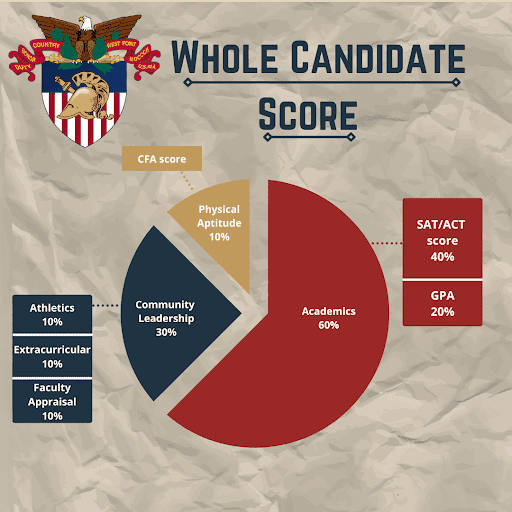
To determine this fit, the Admissions committee scores each applicant using a “Whole Candidate Score” approach. This approach is broken into three domains – Academic, Community Leadership, and Physical Aptitude. Each domain is weighted as a part of the total, and the Admissions committee uses this weighted approach to ensure they select the best and the brightest for entrance into the Corps of Cadets. Generally, the framework assesses whether candidates are:
- Eligible
- Competitive
- Qualified
If a candidate meets all of these criteria, then they have the building blocks to earn an appointment to West Point!
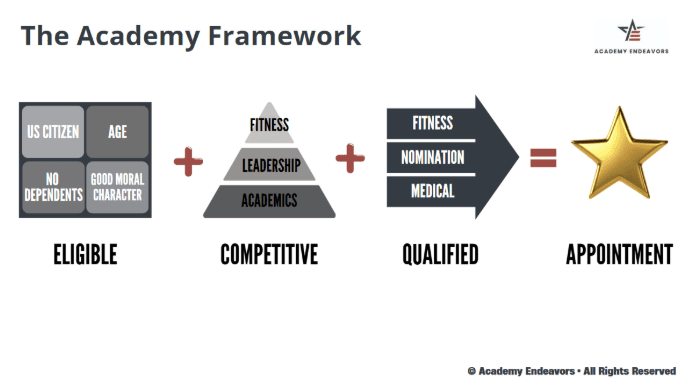
Are you eligible?
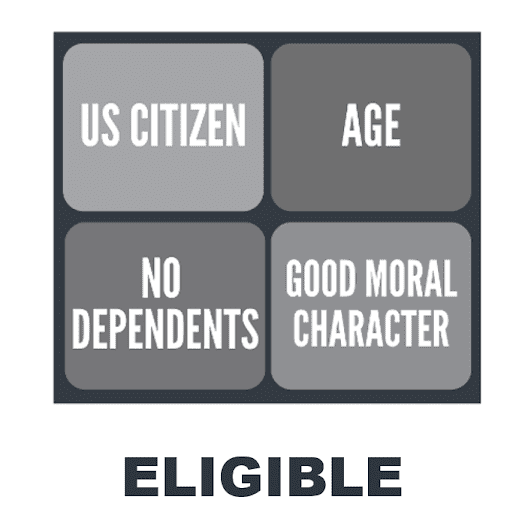
The first part of the Academy process is ensuring that you are eligible for admission to West Point. West Point uses the Candidate Questionnaire (CQ) to determine your eligibility for admission to the Academy. Eligibility is assessed in the following non-negotiable areas:
- Citizenship: Are you a US Citizen? To be admitted to USMA, you must be a US Citizen. If you are not a US Citizen, you may be sponsored by your own nation’s government as part of an agreement between both countries.
- Age: All New Cadets (your title on the day you begin training at USMA) must be at least 17 years old, but not more than 23 years old, on July 1st of the year you enter USMA.
- Dependents: Cadets must be unmarried and have no legal dependents.
- Moral Character: All cadets must demonstrate strong moral character.
If you meet all of these eligibility criteria, then your next challenge is to ensure you are competitive. This is where the Whole Candidate Score really comes to bear – we’ve outlined each of the areas you will compete in below – Academics, Community Leadership, and Physical Aptitude.
Academic excellence.
Unsurprisingly for a school that has been ranked the #1 school in the Nation, the West Point admissions committee heavily weighs applicants based on academic performance. Specifically, the academic performance of an application counts for approximately 60% of the overall application score. How is such a significant portion of the overall academic score assessed?
There are a few key elements that the Admissions committee considers:
- Transcript (20%): The admissions committee will require you to submit transcripts from your freshman year of high-school through your 1st semester of your senior year of high school. If you have completed high school before applying (for those who might have done a year of college, enlisted in the Armed Forces, or had other experiences), then you should expect to submit the transcripts from all schooling completed from your freshman year of high school and beyond. From a performance perspective, the admissions committee is looking for above average performance across all disciplines, with a specific focus on your performance in STEM classes (Pre-Calculus, Calculus, Chemistry, Physics, and Biology are of particular interest). You should specifically look to enroll in IB, AP, Honors, and Dual Enrollment courses. These are all indicators of the level of difficulty you pursued in your course load. West Point is seeking not just high-performing individuals; it is also looking for those individuals who seek out opportunities to push and challenge themselves, even when it’s not required. Enrollment in IB, AP, Honors and/or Dual Enrollment courses is an indicator that you are this type of individual.
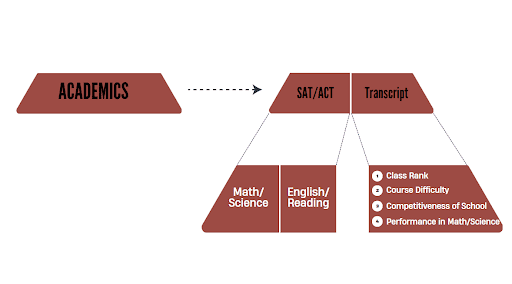
- SAT / ACT (40%): Another key consideration is your performance on standardized college aptitude tests. West Point will consider either the SAT or the ACT; you are not required to take both, but you can submit both. It would be worthwhile to consider if you tend to score better on one form of the test than another. A key consideration to keep in mind is that the Admissions Committee will accept a “superscore”.
What does that mean? Let’s consider Alex; Alex is a high school Senior who takes the SAT and receives a fantastic score on the Verbal portion of the test, but a mediocre score on the Math portion of the test. Alex knows that this won’t make the cut for West Point, so Alex takes the SAT again; but this time, Alex focuses preparation on the Math portion of the test and doesn’t focus on preparing for the Verbal portion. On test day, Alex absolutely shines on the Math portion of the test and gets an SAT score that reflects a phenomenal Math score. Alex submits both SAT scores to the USMA admissions committee, and they accept the highest sub-score from each test. As a result, Alex’s composite SAT score is the fantastic Verbal score from Test 1 and the phenomenal Math score from Test 2. Both times that Alex took the SAT, Alex ensured that the school codes for USMA, as well as each of Alex’s elected representatives were included so scores could automatically be reported. West Points SAT school code is 2924, and ACT school code is 2976.
Why does all of this academic performance matter so much? Beyond the prestigious academic reputation of West Point, there are important reasons that your academic performance plays such a significant role in your application.
- All graduates from West Point receive a Bachelors of Science. While most schools offer both Bachelors of Science and a Bachelors of Arts degree-conferring programs, West Point confers a Bachelors of Science to all graduates (even those who major in French; Art, Philosophy and Literature; or History). This is because West Point was founded as an Engineering program designed to train and commission Engineers who would aid in literally building our Nation.
- Heavy STEM core curriculum designed to develop critical thinkers and problem solvers. Beyond the accreditation requirements for conferring a Bachelors of Science to each graduate, West Point also includes a heavy STEM core curriculum because it teaches critical thinking and structured problem solving. In your time as a cadet you can expect to take 4 math courses, 3 science courses (with labs), and at least 2 IT/Cyber or Computer Science courses.
- Academic rigor and course load that is unparalleled. Every cadet is required to take a minimum of 12 credit hours per semester. With that said, most cadets average somewhere between 15 – 18 credit hours per semester, with some taking on additional course load because they are pursuing a double-major, or a minor in a specific field of study. Another factor in the academic rigor and course load is that each cadet that is not declaring a major in one of the Engineering disciplines (Mechanical, Electrical, Civil, Aeronautical, Nuclear, Systems, or Chemical) is required to enroll in a “Engineering track.” This engineering track is 3 courses taken in one of the disciplines listed, and while it does not qualify as a Minor in engineering, it functionally serves to ensure that each graduate has a basis in engineering.
You might ask – is this focus on academic performance and excellence worth it, especially for an institution that exists to commission graduates as Army Officers? We’d offer that the proof is in the product. To highlight that point, consider the following:
- Merit Scholarships: West Point has had literally hundreds of graduates earn distinguished graduate scholarships over the years; this includes over 100 Rhoads scholars, 30 Truman scholars, 30 Marshall scholars, 45 Fulbright scholars, and dozens of medical school scholarships.
- Published research by undergraduates. While most colleges and universities focus their research efforts on graduate and post-graduate students and faculty, West Point has a robust undergraduate research program. Even more unique is the fact that much of this research is focused on helping solve key challenges in the US Army; this means that you have the chance to create an impact in the very formation that you will be joining and leading just a few short months after you graduate from West Point.
The key takeaways for you? Push yourself to take challenging courses; demonstrate consistent high performance across multiple semesters; and absolutely excel on your SAT/ACT. In your essays and interview, articulate your academic strengths and how you can leverage those to succeed at USMA and as a critical thinker and problem solver serving in the US Army!
“To Commission Leaders of Character…”
These words are part of the USMA Mission Statement, and they are core to what the Admissions Committee is looking for in a cadet candidate. West Point’s values of Duty – Honor – Country and the Cadet Honor Code (A Cadet will not lie, cheat, steal, or tolerate those who do) are not only carved in granite across the campus; they are integrated into the 47-month experience with the goal of carving them into the hearts and minds of each graduate of West Point.
As the premier leader development institution in the world, West Point places a high emphasis on ethical leadership. This is proven out in the course work that all cadets take that is focused on Professional Military Ethics Education, scenario based training vignettes throughout the academic year, as well as the summer and academic year leadership assignments you have starting your Sophomore (also called “Yearling”) year. This is all part of preparing you to join the US Army as an officer and a leader, capable of making the right decision, under pressure, when it matters most.
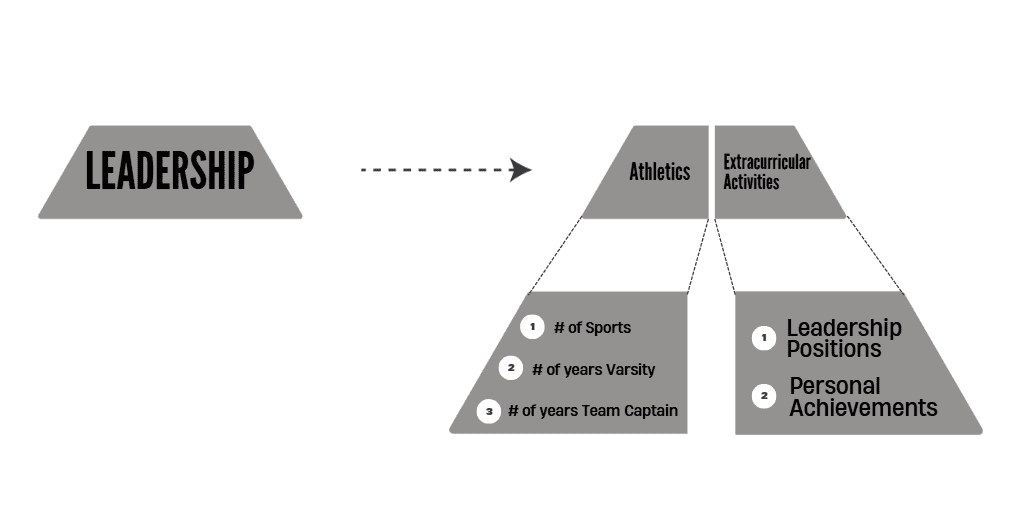
Community Leadership and Character are weighted as 30% of the applicant score. So how can you demonstrate your character and leadership potential, and how will you be assessed for these?
- Demonstrated positions of leadership (10%). Are you involved in extracurricular activities with school? Whether national honors society, student government/council, academic clubs, service-oriented groups, or other affinity groups, holding a position as a captain, president, club officer, or other nominative leadership position is something you want to highlight on your application, as these are weighted at approximately 10% of your applicant score.
- Athletic involvement and achievement (10%). While you might think that this is more directly related to the physical fitness component of the applicant score, your involvement in athletic activities is also an indicator of your leadership and character. It’s important that you highlight any opportunities you have had to be a team captain, to letter in a Varsity sport, and to perform athletically in a way that has earned a special award (MVP) or honor. If you are in club athletics, or homeschooled and don’t have the same access to high school competitive athletics, look for creative ways to demonstrate your athletic involvement; ask for club teams to consider creating captain positions, register for local road races and triathlons, and find ways to engage.
- Evaluations that highlight these elements (10%). USMA’s admissions committee requires you to include “School Official Evaluations” (SOE’s) as part of your application. These are essentially letters of recommendation from faculty members at your school. When you are considering who you will ask to write these SOE’s for you, ensure you select individuals who can speak to your leadership and character, as well as your academic and physical performance. USMA requires Math, Chemistry, Physics, and PE teachers to write these. Equip these teachers with the tools and information necessary to succeed! This means that you need to provide them with a complete picture of who you are, provide your resume and examples of how you have demonstrated key characteristics, and give them a deadline for submission. Be invested in your success!
- Communicating your alignment with USMA values and Army values. In your essays (called Candidate Statements for the USMA application), ensure you demonstrate how your own personal values and demonstrated character align with those of USMA and the US Army. Look for ways to specifically articulate this, sharing stories and examples that highlight that alignment.
“On the fields of friendly strife are sown the seed that…bear the fruits of victory” – GEN Douglas MacArthur, USMA Class of 1903.
One of the famous sayings at West Point is “Every Cadet an Athlete.” Why? Because athletics often serves as the context for demonstrating grit and performance character, moral character, and your ability to both be a member of a team and a leader of a team. Whether you are playing in NCAA athletics, club athletics, or intramurals, you should expect to be engaged in athletic activity throughout your entire cadet career. Additionally, the 47-month experience at West Point is an extremely physical one; beyond athletics, you will be conducting physical fitness tests every 6 months (the Army Combat Test – not required as part of your application, but you’ll take this for the first time at the end of Beast Barracks) and military training to prepare you to lead in a variety of tough and challenging situations, preparing you for your role as an officer and a leader in the US Army.
Representing the final 10% of the applicant score, how is your physical fitness assessed?
- Candidate Fitness Assessment. This is the primary mechanism, level set for all applicants and most heavily weighted in assessing the Physical domain in the Whole Candidate Assessment. This is the only physical fitness test you will take as part of the application / admission process. You want to ensure you submit the best scores possible! You are authorized to take this test as many times as you need to, so ensure you prepare, train, and then absolutely crush it on the day of your test – you can find our free training program here. If you don’t feel that you performed at your best, then ensure you make time and coordinate with an authorized testing official to take another Candidate Fitness Assessment and include the updated scores with your application. It’s important to note that USMA requires you to record your push-ups and sit-ups and submit a video of your form – so ensure that you practice your form! Practice doesn’t make perfect – perfect practice makes perfect.
- Athletic participation / achievements. While the admissions committee will most closely look at your Candidate Fitness Assessment scores to determine your physical fitness and readiness for USMA, they will also want to understand your extracurricular athletic activities. Participation, and lettering, in school sports is an important distinction; you can also include notable achievements that might not be traditionally available in a school setting (e.g. club/travel sports, 5K/10K’s, triathlons, dance, etc.)
Qualified to Compete.
Beyond being eligible and competitive for nomination and admission to West Point, you also need to be qualified. What goes into being qualified? There are three components to this:
- Candidate Fitness Assessment. All applicants must successfully complete and submit their scores for the Candidate Fitness Assessment (CFA). We already spoke about the requirements there, and will say again – train for this, prepare for it, and perform at your absolute best!
- Nomination. All applicants must be nominated to attend the United States Military Academy. There are multiple nomination sources, each with their own unique application process – we address that below, so be sure to check out our discussion on nominations as part of the overall application process.
- Medical fitness for duty. All members of the US Armed Forces go through a medical screening to ensure they are capable of handling the rigors of service; applicants to West Point are no exception! This medical screening, called the DoDMERB (Dept. of Defense Medical Examination Review Board), is something that you will go through as part of your application. You can find more specific information about the DoDMERB and what you can expect of that process here.
Understand the Admissions Process.
Unlike almost any other 4-year institution, you have to fill out multiple applications (normally around 7!) to be accepted into West Point (more on this below). This is why we stress the importance of starting early, having a schedule and a plan, and committing to following your plan. We’ve included this graphic outlining the West Point Admissions Timeline, and shared more detail on each of the applications required below.
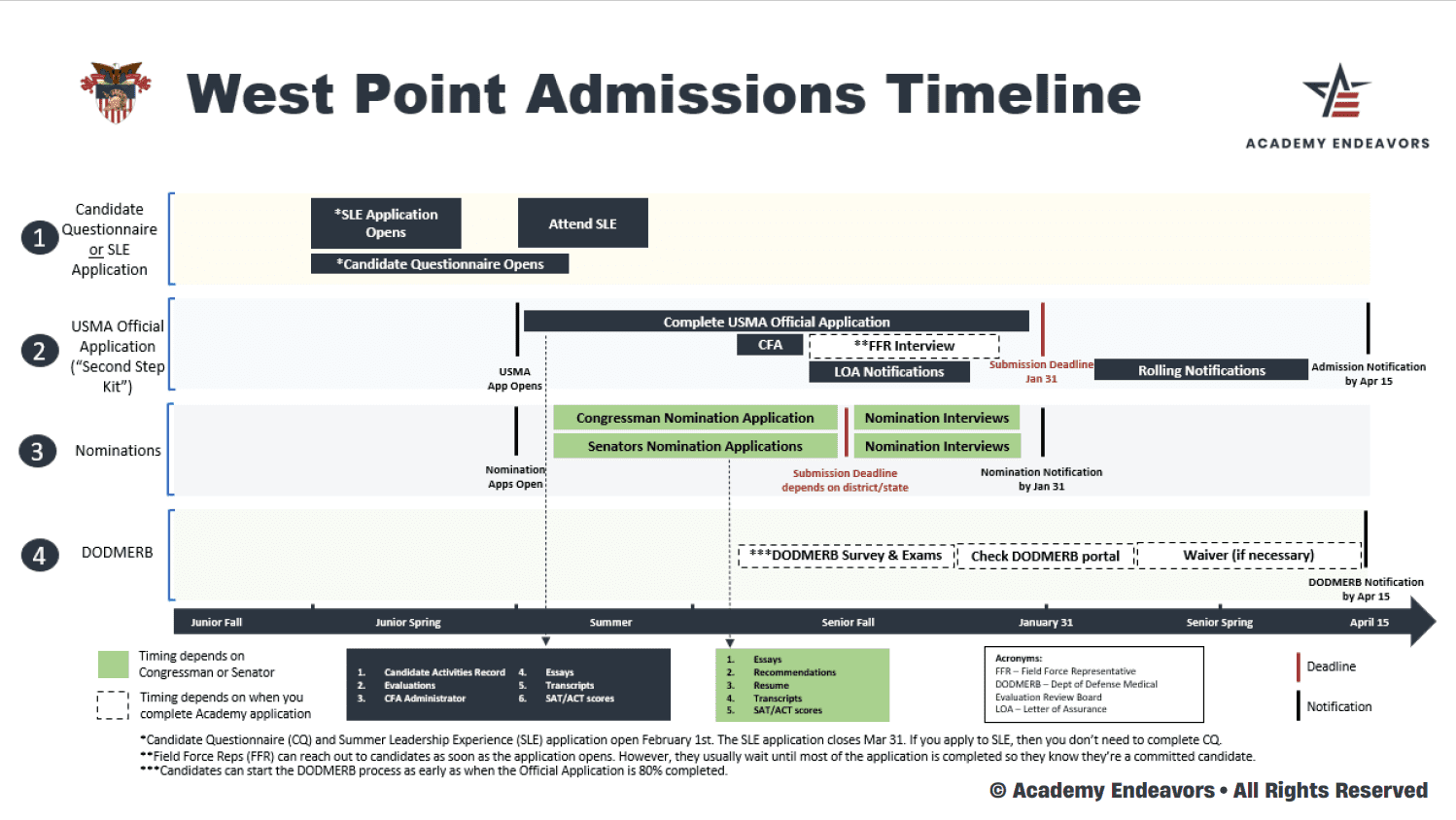
It is important to view this as a process – you will not prepare, apply, qualify, and receive acceptance overnight – so start early, be intentional, and understand the process. At Academy Endeavors, we have deep experience in navigating this process – with an +85% success rate in helping our clients earn nomination and admission to a Service Academy. If you’re looking to substantially increase your chances of joining the Long Gray Line, then book a call with us today.
Applications formally open on or around May 15th each year for candidates who are seeking admission to the class that begins the following year (e.g. May 15th, 2026 for candidates seeking admission to the class that begins in 2027 and graduates in 2031). There are multiple applications you will need to complete (more on that below). For planning purposes, based on our extensive experience in coaching candidates to success in earning a nomination to West Point, we strongly advise you to be complete with your Academy application and all congressional nomination applications no later than August 31st. Once you submit these, the Admissions committee will begin review of your application alongside all other applicants. At the same time, your congressional nomination committee(s) will review your packet.
It’s important to note that the West Point admissions committee uses a “rolling admission” process; this means that they review applications as they are received, and will be willing to make conditional offers of acceptance (conditional on you receiving a nomination, and being found medically fit for service). This means that the earlier you apply to West Point, the better the chances that you will be accepted!
Every application, Every detail = Every opportunity maximized.
One of the unique requirements to go to West Point is that you have to apply and be admitted by the Admissions Committee, and you must also receive a nomination from an appointing official. Appointing officials include US Representatives, US Senators, the Vice President of the United States, and for select groups of candidates the President of the United States or the Superintendent of West Point.
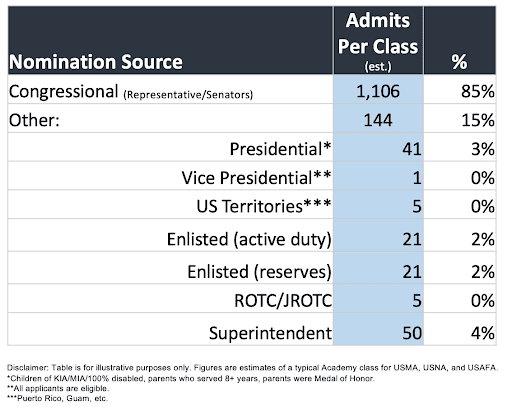
It is important that you apply to each of the appointing officials who you qualify for – for most candidates this means your elected Representative, both of your states’ US Senators, and the Vice President. Each appointing official has a different application, process, and timeline for Service Academy nominations, so ensure you check their websites for the specific information you need.
The applications that you can expect to complete in order to compete for a spot as a cadet at West Point include:
- Candidate Questionnaire. This is a short questionnaire that serves as a “pre-application” for the USMA Admissions Office, and indicates your interest in learning more about gaining admission to West Point. This is also the first step you take in applying to go to a Summer Leaders Experience (SLE) – a one-week immersive on-campus experience hosted at West Point during the summer of your Junior year. You can find the Candidate Questionnaire here.
- USMA Application. Traditionally called the “Second Step Kit” (SSK), this is the application that goes directly to the Admissions committee. This application generally opens on or around May 15th each year; you should plan to complete the entire application by August 31st! The deadline from USMA is January 31st each year; that said, West Point admissions uses a “rolling admissions” process – that means that as applications are received, they are reviewed and offers of admission are made. It is absolutely in your favor to apply early!
- US Representative Nomination application. Each US Representative (you can find yours here) is able to nominate or “sponsor” 10 cadets at USMA at a given time (that means that no more than 10 people can be at the Academy, sponsored by that Representative, across all 4 class years). Each Representative will nominate at least one candidate(s) from their district to West Point each year; sometimes they may nominate more (if they have space in the total cap of 10/Representative). While each representative is able to establish their own process for a congressional nomination, they generally do the following for constituents:
- Open an application portal or provide instructions on their official government website
- Appoint a Service Academy Nomination/Selection Committee
- Review applications from interested constituents
- Interview well qualified candidates
- Select and notify candidates and the West Point Admissions committee of their selection
- US Senator 1 Nomination application. Similar to the US Representative, each US Senator is able to nominate 10 cadets at USMA at a given time. The key difference is that while a US Representative only nominates candidates from within their Congressional district, the US Senator may nominate candidates from across their entire state. You can find your Senator here.
- US Senator 2 Nomination application. You’ll likely remember from your US Government class that each state has 2 US Senators, regardless of how big or small that state is. This means that you need to apply to each of your US Senator’s offices for a nomination to West Point!
- Vice Presidential Nomination application. Congress allows the Vice President of the United States to nominate 250 candidates for West Point. Given that the Vice President has jurisdiction across all 50 states, this is a highly competitive pool of applicants – but don’t count yourself out! It is critical that you also apply for a Vice Presidential nomination.
- DoDMERB. One of many acronyms that you will learn, the DoDMERB stands for Department of Defense Medical Examination Review Board. This is an extensive medical screening process to ensure you are medically fit for service in the US Army. This is another application that you must complete as you pursue your goal of gaining admission to West Point – you can find more information on the DoDMERB here.
- Other nomination sources. There are a few other nomination sources for special cases; some of these include:
- Active Duty / Reserve service members: If you are already enlisted, you have an opportunity to apply for entrance to West Point. Contact the Admissions Office today to learn more about the specifics of this option.
- ROTC service members: if you are already enrolled in ROTC and pursuing a commission, you are also eligible to apply for a nomination to West Point.
- Child of a DoD Uniformed Service Member retiree. There are a number of slots in each USMA class for children of DoD Uniformed Service Members that served a full career in the military and retired. If one of your parents meets this criteria, you can qualify to apply for one of these slots!
- Child of a Congressional Medal of Honor (MoH) awardee. In recognition of the incredible valor and service of Congressional Medal of Honor winners, any child of an MoH awardee who is qualified (medically, physically, academically) is guaranteed admission to West Point.
You can find more information and have all your questions about nominations answered in depth here.
It’s crucial that you answer consistently, truthfully, and as clearly as possible across each application. It’s also important that you not only answer what the question is asking, but also look to present a clear case for why you are a great fit for USMA and for the US Army.
Essays/Candidate Statements: you can check out our full guide to outstanding essays here, but in short, ensure your essays are:
- Personal
- Specific
- Passionate
How do you do this? Tell your story, in a memorable, concise, and clear fashion – use the STAR format! This works in both written responses, as well as interview settings. What is the STAR format, and why does it work? STAR stands for:
- Situation
- Task
- Action
- Result
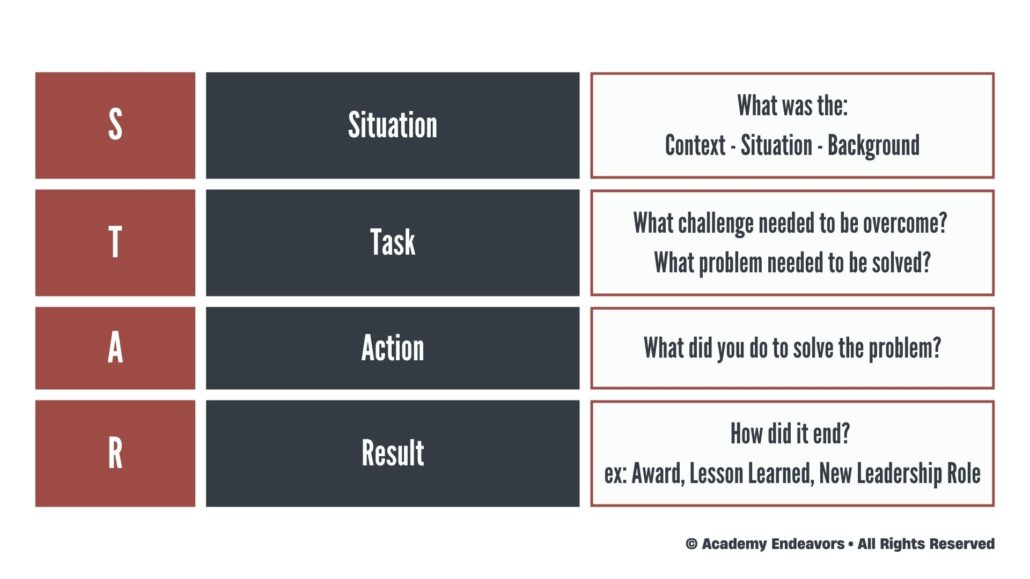
In your essays or interviews when answering a question, start with a brief description of the
- Situation. What is the context for this story? Set the scene briefly.
- Task. What was your specific task or role in this story? Provide enough detail to ensure that its very clear what the task or goal is.
- Action. What action, or actions, did you take to ensure you accomplished the task? While it’s tempting to focus on what the team did, West Point isn’t looking to admit your team; they are assessing you.
- Result. What was the outcome of the action you took? Provide a clear description of the result, and ensure it is directly linked to your task and action.
Many of the questions we use to prepare our clients for interviews highlight the opportunity to use the STAR framework. Here’s a few that you can practice with:
- Tell me about a time where you failed. What happened, and what did you learn from it?
- Which achievement are you most proud of, and why?
- Tell me about a time you faced an ethical dilemma – what did you choose, and why?
- Would you describe a time when you came up with a unique solution to a problem?
- What do you plan to do if you don’t get accepted to West Point?
Why is this format so effective? Because it enables you to tell your authentic story. You aren’t just listing facts (your resume does that), you are painting a picture of who you are as a leader, a learner, and a future Army officer.
In all of your applications, interviews, and interactions, it’s important that you stand out – remember, you are competing against other incredible candidates for a coveted slot at THE United States Military Academy! What are some key ways you can stand out?
- Academic performance: Aim for a GPA of 3.8 or higher and an SAT of 1400+ or ACT of 33+.
- Extracurricular activities: Demonstrate genuine service and commitment to building community.
- Athletic leadership: Don’t just play sports, seek out opportunities to be a leader on the field, court, pool, floor, etc. Earn Varsity letters, be appointed Team Captain, earn honors.
- Community engagement:
- Service & Clubs: leadership roles in groups like Circle K, Boys/Girls State, DECA, MUN
- Scouts: Eagle Scout / Gold Award
- Officer in JROTC, Civil Air Patrol or Sea Cadets
- Compelling essays and crushing the interviews: Reflect, Prepare, and use the STAR format!
- SLE attendance: Immerse yourself in the cadet experience and gain first-hand knowledge of the West Point experience by attending the Summer Leaders Experience.
- Whole Candidate Story: Your challenge is to make your application stand out, to be more than just your Whole Candidate Score – you want to present a Whole Candidate Story, a memorable and desirable candidate who presents in a cohesive, clear, and compelling manner.
All of these keys to standing out require hard work, commitment, discipline, and follow-through. Being able to then tailor them together into a compelling story of why you should earn admission to West Point is another level of effort – and AE is here to make that come through!
Key Considerations to ensure you are making one of the most important decisions of your life.
By this point you realize that West Point isn’t for everyone; the entire Admissions Process is designed to highlight that, seeking to weed out those who aren’t supposed to be part of the Long Gray Line – whether by determining they aren’t eligible, competitive, or qualified. But before you let the Admissions Committee make an assessment, you need to first consider – is West Point for you? There are several key considerations to keep in mind; we’ve highlighted what we believe are the top three.
Fits like a glove (or like your Dress Gray uniform, tailored specifically to you).
The importance of “fit” can’t be overstated – but what does that really mean? To understand that, there are two questions you must consider:
- Is West Point, and serving as an Officer in the US Army, the right fit for you? If you are motivated to do hard things, to push yourself, to be placed in an environment where you will consistently be challenged, equipped, and expected to rise to the occasion, then yes – this is likely the right fit for you.
- Are you the right fit for USMA? West Point is an institution that is over 200 years old; while there have certainly been changes and adaptations at the Academy over that time, one of the reasons it is still as strong as it is today is because of the institutional values, traditions, and principles that are as firm as the granite bedrock that the buildings at West Point sit on. Don’t expect the institution to change for you; while you can absolutely impact the institution, you must recognize that it will have a far greater impact on shaping, developing, and molding you. if you are eager to join a rich heritage of service, contribute to the tradition of excellence, and “grip hands” with the many graduates who have gone before you and will come after you, then you are on the right track!
“To Support and Defend the Constitution of the United States”
On graduation day, each graduate of West Point swears the oath of an Officer in the Armed Forces of the United States. While your obligated to serve for 5 years on Active Duty as a US Army Officer, your service goes beyond that. That service might look different after the first 5 years – some will choose to remain in uniform, continuing to lead Soldiers. Others will move to the private sector, still serving as leaders of character in their workplaces, communities, and families; others may go into public service, run for public office, or otherwise find ways to serve. Bottom line – service to the nation will take different forms for graduates of West Point, but all graduates are committed to service to the nation. If that resonates with you, then West Point is a great option!
The closest knit alumni in the world.
West Point boasts the closest knit alumni in the world; the shared experience of the 4 most intensive and formative years of your life, regardless of when you attended and graduated from West Point, create bonds that can’t easily be described. This means that you also have incredible lifetime connections – not just with your own classmates and the cadets who were at the Academy at the same time as you, but also with the faculty, other “Old Grads”, and even other Service Academy alumni. This is truly something special – it’s also an awesome responsibility for you to uphold, if you choose to join the ranks of the Long Gray Line.
What to do if you don’t get into the Academy.
The statistics are clear – 90% of the applicants that start the process, don’t actually gain admission into West Point. Our goal is to equip you to be part of the 10% that do, but the question remains – what should you do if you don’t get into the Academy, and yet you are still convinced that this is the path for you?
First, take a breath – this isn’t the end of the world. From my own personal experience, I applied and didn’t get in on the first attempt. While I was incredibly upset, I can reflect and recognize that this is one of the best things that has happened to me – it taught me that failure isn’t final, that it’s a starting point for improvement; it also taught me the value of pursuing goals that are hard to reach, that invite the opportunity for failure. I was still resolved to gain admission, and after speaking with my Admissions Officer at USMA, my Field Force Representative, and considering my options, I doubled down on my efforts to gain admission into the following class. There are a few important steps you can take if you find yourself in the same shoes I was in; these aren’t mutually exclusive steps, and should all be considered as part of your campaign to gain admission:
- Re-Apply: If you are still convinced that West Point is for you, then you should absolutely re-apply. Applicants who are not initially admitted, and then re-apply the following year, demonstrate the grit and tenacity that West Point seeks in cadets.
- Pursue a commission: West Point is not the only path to a commission as an Officer in the US Army. Remember, while graduating from West Point is an incredible goal, graduation is just the starting line – the real goal, the finish line, is “a lifetime of service to the Nation”, starting with a commission as an Officer in the US Army. There are other routes to commissioning! If you don’t get into the Academy, we recommend you enroll in a 4-year university with an ROTC program, and participate in that ROTC program. This shows the Admissions Committee that you are dedicated to pursuing a commission, regardless of whether that is through USMA or another means.
- Shore up your weak areas: An added benefit to enrolling in a 4-year university with an ROTC program is that it will allow you to take collegiate courses that can shore up areas of your transcript that might be weak. You should focus on enrolling in full semesters (approximately 15 credit hours), and enroll in courses that are STEM heavy (e.g. Calculus, Chemistry with Lab, Physics with Lab, Biology with Lab, Statistics and Probability) and earning excellent grades. You can look for continued athletic opportunities through club athletics, and engage in community leadership and service opportunities.
Remember – failure to gain admission to West Point isn’t final. While it will feel like a setback, it will provide you perspective, empathy, and a deeper resolve and conviction to pursue your goals with a singular focus. Know that there is a whole team of supporters there to encourage you and equip you to succeed as you go through the process again. If we can help in any way, don’t hesitate to reach out and book a coaching session with Academy Endeavors!
A decision that will change your life.
Being a West Pointer is an incredible privilege and accomplishment; not everyone earns the right to call themselves by that title. It represents an immense amount of hard work, grit, commitment to excellence, and outstanding character – and that starts with just the application process. It’s clearly not for everyone, but that is part of what makes it so unique, invaluable, and exceptional.
If you have a desire to be pushed to excel, to grow in your character, determination, and leadership, to have the opportunity to serve your Nation as an Officer in the US Army, and to be part of one of the greatest and most selective communities in the world, then all of this work on the applications is worth it. You also don’t have to go about it alone! The USMA admissions committee provides a wealth of information, your family, guidance counselors, teachers, coaches and friends can support you through the process, and Academy Endeavors is ready to enable you to achieve a truly life-changing accomplishment – reach out to us today for a free coaching call to make your dream a reality.
Frequently Asked Questions
We’ve included several questions that we often hear at Academy Endeavors below. You can also find a great list of FAQ’s directly on the West Point Admissions website here.
- What’s the difference between an appointment and a nomination?
- A nomination is required to be considered for admission. An appointment is your actual offer of admission from USMA.
- How do I get a nomination?
- Most students apply through their Senators and Representative. You can also apply through other sources like the Vice President or service-affiliated nominations (Presidential, ROTC, etc.). See more about this in step six or read our blog here: How To Get A Congressional Nomination – Academy Endeavors
- How hard is the CFA?
- It’s challenging—especially because failing even one of the six events means you fail the whole thing. Train seriously, do mock tests, and don’t wait until the last minute.
- What if I’m medically disqualified by DoDMERB?
- Roughly 20% of applicants face a disqualification. Some receive waivers—but only if you apply early enough to start that process. Don’t wait to start your DoDMERB. Check out our guide here to help you understand the DoDMERB.
- What should I expect in the Field Force Representative interview?
- It may be in person or virtual; either way, it’s a structured interview that assesses your leadership, character, communication, and motivation to serve. While it may feel informal and rapport building, you are being assessed. Show up early, prepared, and polished.
- Can I reapply if I don’t get in the first time?
- Yes! Many successful cadets earn appointments on their second or even third attempt. Reapplying with stronger academics, leadership, and fitness is a valid path. The Academies look highly upon re-applicants as it shows perseverance.
- What are other ways to become an officer if I don’t attend USMA?
- Consider Army ROTC at a civilian college, Army ROTC scholarships, or Officer Candidate School (OCS) after graduation.
- How is the process different for homeschool applicants? Do you have any advice for them?
- Being a homeschool applicant can feel particularly challenging, as some of the requirements on the applications are written for the “traditional” candidate coming from a public or private school. Don’t be discouraged! There are several homeschooled candidates that are immensely successful cadets and Officers. Talk to your Admissions Officer and Field Force Representative about your circumstances, and offer creative solutions (things like participating and leading in club athletics, enrolling in community college (dual enrollment) courses while in high school, asking if a family friend who is a PE teacher can administer the CFA, etc.) to some of the challenges.
Follow the link below to schedule a free 1-on-1 consultation with our CEO!


